Definition of Khula in Islam
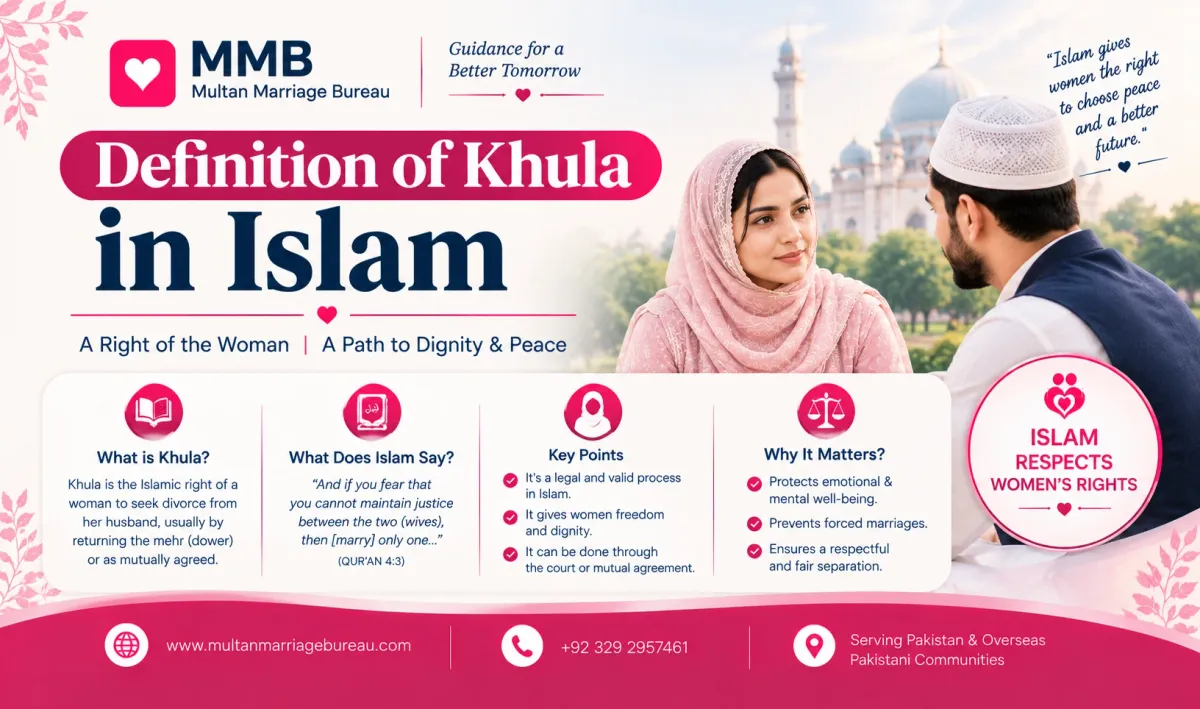
Khula is a Muslim woman's Islamic right to end her marriage. The word comes from the Arabic khal' (خلع), meaning “to take off” or “remove” — as one removes a garment. In simple terms, it is a divorce initiated by the wife, in return for giving back her mahr (dower) or an agreed compensation. This guide explains what khula means, how it works in Pakistan, and the rights it protects.
What is khula in Islam?
Khula is the right of a Muslim wife to seek release from her marriage when living together within the limits of Islam becomes impossible. While talaq is divorce initiated by the husband, khula is initiated by the wife. Its legitimacy comes from the Quran (Surah Al-Baqarah 2:229) and the practice of the Prophet ﷺ, who granted khula to a woman who could no longer continue her marriage. In return, the wife generally returns the mahr she received.
Khula vs talaq vs mubarat — what's the difference?
- Khula — initiated by the wife; she usually returns the mahr.
- Talaq — initiated by the husband.
- Mubarat — divorce by mutual agreement of both spouses.
How does the khula process work in Pakistan?
In Pakistan, khula is granted through the Family Court under the Muslim Family Laws Ordinance 1961 and the Family Courts Act 1964. Importantly, the husband's consent is not required — the court can dissolve the marriage if reconciliation fails. The typical steps are:
- File a petition — the wife files a suit for dissolution of marriage in the Family Court where she resides.
- Court notice — the court sends the husband a notice to appear and respond.
- Reconciliation — the court first attempts reconciliation between the spouses.
- Decree — if reconciliation fails, the court passes a khula decree, usually with return of the mahr.
- Certificate — the Union Council completes the legal record and issues a divorce certificate.
The process usually takes around 2–4 months, depending on the court and documentation.
What rights does a woman have in khula?
Both Islamic law and Pakistani family law protect a woman's rights during and after khula, including the right to fair treatment (she cannot be coerced), the right to legal representation, and — depending on circumstances — rights relating to children's custody and maintenance. Khula exists precisely so that a woman is not trapped in a harmful or impossible marriage.
Khula reflects the balance in Islam — it upholds the sanctity of marriage while protecting a woman's dignity and right to leave an unbearable one.
Life after khula: a new beginning
After khula and the completion of iddah (the waiting period), a woman is free to remarry. Islam encourages remarriage, and there is no stigma in seeking a new, blessed union. If and when you are ready, you can explore a respectful second marriage rishta — our guide on second marriage in Pakistan covers this with dignity and privacy.
Frequently Asked Questions
What is khula in simple words?
Khula is a divorce initiated by a Muslim wife. She ends the marriage, usually by returning her mahr (dower), and in Pakistan it is granted by the Family Court — even without the husband's consent.
How is khula different from talaq?
Talaq is initiated by the husband; khula is initiated by the wife. In khula, the wife typically returns the mahr to obtain the separation.
Can a husband refuse khula in Pakistan?
No. In Pakistan the Family Court can grant khula even if the husband does not consent, once reconciliation fails. His refusal does not block the decree.
How long does khula take in Pakistan?
It usually takes about 2 to 4 months, depending on the court, documentation and whether reconciliation is attempted.
Can a woman remarry after khula?
Yes. After khula and completing the iddah (waiting period), a woman may remarry. Islam encourages remarriage, and you can find a respectful second marriage rishta when ready.
Note: This article is for general information only and is not legal advice. For your specific situation, please consult a qualified family lawyer or scholar.
A dignified fresh start
Whatever your past, a happy, blessed marriage is your right. When you feel ready, Multan Marriage Bureau helps you find a genuine, private rishta with dignity. Create your free profile, or read our guide on finding a genuine, verified rishta.