Abroad Marriage Proposals
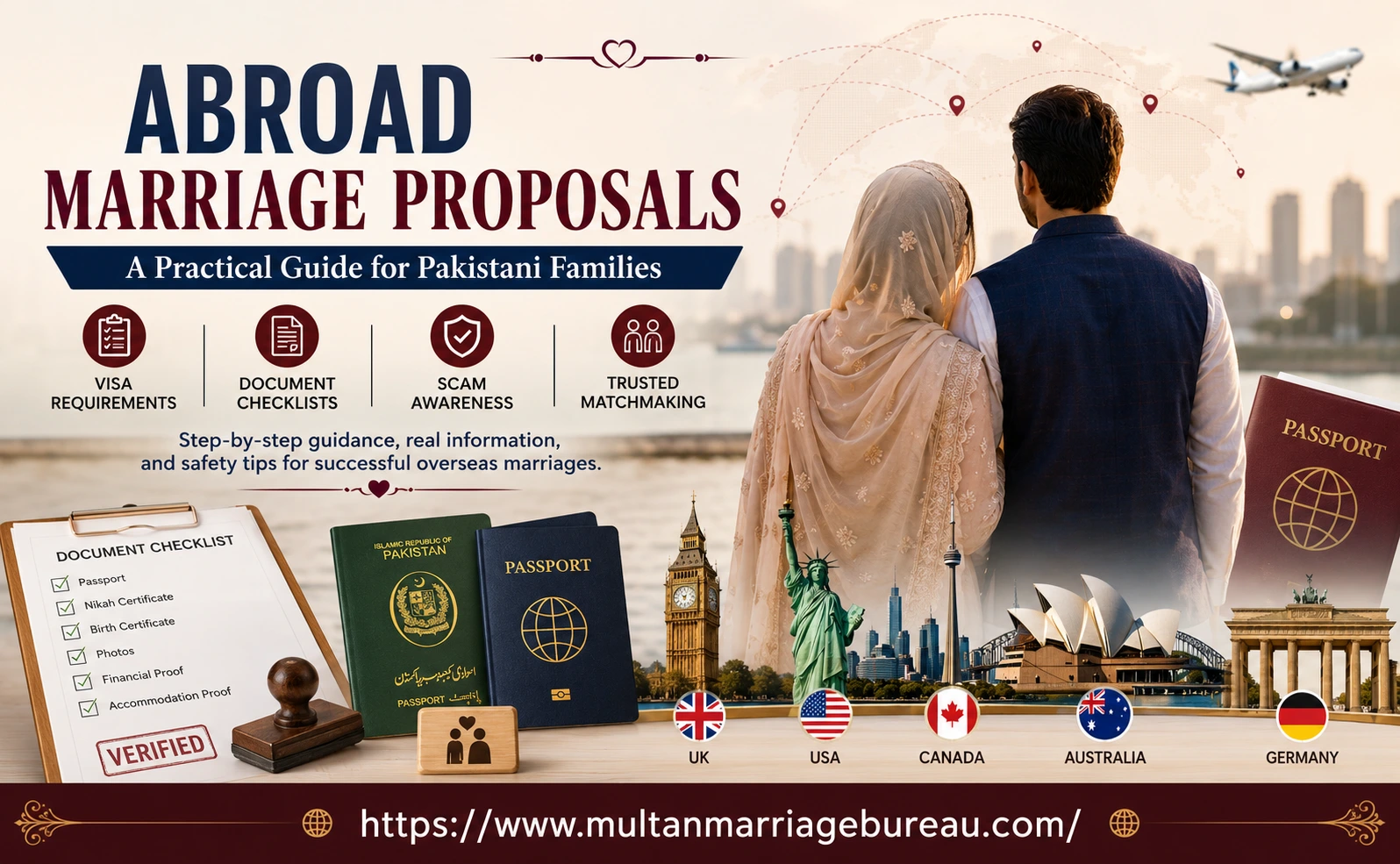
Abroad Marriage Proposals: What Actually Happens, Step by Step
Real visa requirements, an honest look at timelines, a document checklist, and the scam patterns to watch for — everything a family needs before saying yes to a proposal from abroad.
An abroad marriage proposal isn't just a rishta with extra paperwork — it's a matchmaking decision and an immigration process happening at the same time, and treating it as only the first one is where most families run into trouble. This guide walks through both halves honestly: how the matchmaking side typically unfolds, what five major destination countries actually require on the visa side as of 2026, and the specific scam patterns families should watch for when a proposal comes from overseas.
How an Abroad Proposal Actually Unfolds
- Verified introduction — a matchmaker or family connection shares profiles between both sides, ideally after some level of identity verification on the overseas party.
- Video conversations, not just photos — before any commitment, both families should have direct video calls, not just an exchange of pictures and a biodata.
- Building a real relationship record — regular calls, messages, and (where possible) an in-person visit start forming the evidence a visa application will eventually need.
- Nikah, timed correctly — whether the Nikah happens before or after the visa application depends entirely on which visa category applies, covered in the country sections below.
- Visa filing with a licensed adviser — this stage is generally handled by a licensed immigration lawyer or adviser in the relevant country, not by the matchmaking service.
- Interview and decision — most routes include a consular interview where the couple is asked about the relationship; consistent, honest answers matter more than rehearsed ones.
Visa Routes at a Glance
These are the most common routes Pakistani families encounter. Fees, thresholds, and processing times shift often, so treat the figures below as a general orientation, not a guarantee.
| Country | Typical Route | Married Before Applying? | Key Requirement |
|---|---|---|---|
| United Kingdom | Spouse Visa | Yes | Sponsor's income generally at least £29,000/year, plus genuine-relationship evidence |
| United States | K-1 Fiancé Visa | No — marry within 90 days of arrival | Sponsor is a U.S. citizen; met in person within 2 years (waiver possible for religious/cultural reasons) |
| United States | CR-1 / IR-1 Spouse Visa | Yes | Bona fide marriage evidence; sponsor files Form I-130 |
| Canada | Spousal Sponsorship | Yes (or common-law equivalent) | Sponsor must meet IRCC eligibility; outland or inland processing options |
| Australia | Partner Visa (Subclass 309/100) | Yes, or de facto for 12+ months | Evidence across four categories: financial, household, social, commitment |
| Germany | Family Reunification (National Visa D) | Yes | Basic German language ability (usually A1) typically required before the visa is granted |
What Each Country Actually Asks For
United Kingdom Spouse Visa
The sponsoring partner in the UK generally needs to show a gross annual income of at least £29,000, though savings or other income sources can sometimes substitute. Applicants from Pakistan are also typically required to take a Home Office-approved TB test before applying.
- Both applicant and sponsor must be 18 or over, and any previous marriages must have legally ended.
- The couple must have met in person and intend to live together permanently in the UK.
- Genuine-relationship evidence matters heavily — joint financial ties, records of ongoing communication, and evidence of visits are commonly requested.
- The initial visa is typically granted for 33 months, with an extension route afterward.
United States K-1 vs CR-1
Couples generally choose between two different starting points. A K-1 fiancé visa lets the couple marry after arrival in the US (within 90 days), while a CR-1 spouse visa requires the marriage to happen first, typically in Pakistan.
- Only a U.S. citizen can sponsor a K-1; a green card holder cannot — they would use the spousal route instead after marrying.
- K-1 applicants generally must show they've met in person within the two years before filing, though a specific waiver exists for couples whose culture or religion strictly prohibits meeting before marriage.
- K-1 cases have historically had a noticeably higher refusal rate than CR-1 cases, often tied to weaker evidence of a genuine relationship.
- Immigration policy in this category has been shifting through 2025 and 2026 — confirm current country-specific guidance before choosing a route.
Canada Spousal Sponsorship
Canada's spousal sponsorship program is managed through IRCC and generally allows two processing pathways: outland (applying from Pakistan) or inland (if already living together in Canada).
- The Canadian sponsor must meet IRCC's eligibility and financial undertaking requirements.
- Common-law and conjugal partnerships have separate criteria from a legally registered marriage.
- Processing times and program details are updated periodically on IRCC's official site — always check there directly.
Australia Partner Visa 309/100
The offshore Partner visa is a combined application: a temporary visa (subclass 309) followed by a permanent one (subclass 100), applied for together with a single fee.
- Evidence is assessed across four categories — financial, household, social, and commitment — and thin evidence in any one area weakens the whole case.
- Applications are generally expected to be largely complete at lodgement, since follow-up requests for missing evidence aren't always issued.
- If the couple is engaged but hasn't lived together for 12 months, the Prospective Marriage visa (subclass 300) is often the starting point instead.
Germany Family Reunification Visa
Spouses joining a partner in Germany generally apply for a National Visa (Category D) for family reunification, processed through the German embassy or consulate.
- Basic German language proficiency (commonly level A1) is typically required before the visa is granted, with some exceptions depending on the sponsoring partner's status.
- The marriage must usually be legally registered and recognized before the application is submitted.
- Requirements can differ depending on whether the sponsor is a German citizen, EU citizen, or a non-EU resident with a valid residence permit — confirm which category applies.
Document Checklist to Start Preparing Early
Identity & Civil Documents
- Valid passport with adequate blank pages
- CNIC matching passport details exactly
- Nikah Nama, registered with the Union Council
- Divorce decree or death certificate, if previously married
Relationship Evidence
- Call logs and message records over time
- Travel records or tickets from any visits
- Photos from the engagement, Nikah, or family gatherings
- Written statements from both families where relevant
Get the Matchmaking Side Right First
A verified, well-documented introduction makes everything after it — Nikah, visa filing, the interview — considerably easier to prepare for.
Register Your Marriage ProfileRishta Scam Patterns to Watch For
Overseas proposals are unfortunately a common target for fraud, precisely because families are often eager and the other side is far away and hard to verify. These are the patterns worth knowing:
Upfront payment requests
Any request for money — for "processing," "visa guarantee," or "travel costs" — before a verified family introduction is a serious red flag. Legitimate visa fees are paid directly to government portals, not to an individual.
Refusal to do a video call
A prospective match or their family who avoids live video conversation, insisting on photos and voice notes only, deserves extra scrutiny.
Guaranteed visa approval claims
No legitimate matchmaker, agent, or adviser can guarantee a visa outcome. Immigration decisions are made by government authorities, not by intermediaries.
Pressure to rush the Nikah
Genuine proposals allow time for both families to verify details. Heavy pressure to finalize quickly, before proper verification, is a warning sign rather than a sign of sincerity.
Inconsistent personal details
Names, job titles, or locations that shift slightly between conversations are worth raising directly and clarifying before proceeding further.
Islamic Guidance on Nikah Before Travel
Within Islamic tradition, the Nikah itself does not need to wait for a visa to be finalized — many couples complete Nikah in Pakistan and hold the Rukhsati or full ceremony later, once travel is arranged. What matters most is that the marriage is entered into with full consent from both parties, proper witnesses, and clarity about expectations going forward, including practical matters like where the couple will initially live.
Families discussing what happens if a marriage doesn't work out after relocation abroad sometimes also want to understand the definition of khula in Islam, particularly given how much distance and a new legal system can complicate matters if difficulties arise later.
How Multan Marriage Bureau Supports Abroad Proposals
We handle the matchmaking and verification side of the process — not visa filing, which should always go through a licensed immigration adviser in the relevant country. What we do provide: profile verification before any introduction is made, video consultations that work across time zones, and a confidential process that gives both families the space to ask questions before committing.
We regularly support families arranging UK and USA rishta connections, as well as families exploring the Canada, Australia, and Germany routes specifically. If distance and timing pressure are weighing on your family's decision, our piece on the psychological effects of late marriage on men and women may also be a useful read.
Frequently Asked Questions
Does an arranged introduction hurt a spouse visa application?
No. Immigration authorities in the UK, USA, Canada, and Australia all formally accept arranged and family-introduced marriages as genuine. What matters is evidence that the relationship became real and ongoing after the introduction, such as regular calls, visits, and communication between the couple themselves, not just between the families.
Do we need to meet in person before applying for a fiancé or spouse visa?
For the US K-1 fiancé visa, couples generally must have met in person within the two years before filing, though a waiver exists specifically for cases where an in-person meeting would violate strict religious or cultural customs. Requirements differ for the UK, Canada, Australia, and Germany, so confirm the current rule for your specific visa route.
Should the Nikah happen before or after the visa application?
This depends on the visa route. A fiancé-type visa, such as the US K-1, generally requires the couple to still be unmarried at the time of filing, with marriage happening after arrival. A spouse-type visa, such as the UK spouse visa or US CR-1, requires the marriage to have already taken place. Confirm which category applies to your situation before deciding on timing.
How long does an abroad marriage visa process usually take?
Timelines vary significantly by country and visa type, ranging from several months to well over a year, and can shift with processing backlogs. Always check the current processing time on the relevant government's official immigration website rather than relying on a fixed number, since these change.
What's the biggest reason overseas spouse visa applications get refused?
Insufficient or inconsistent evidence that the relationship is genuine and ongoing is one of the most common reasons across most countries, followed by financial requirements not being clearly documented. Thorough, consistent documentation from the start significantly reduces this risk.
Is it safe to send money to someone claiming to be an overseas proposal before meeting their family?
No. Legitimate matchmaking and visa processes never require you to send personal funds to an individual claiming to be a prospective spouse or their representative before a verified family introduction has taken place. Treat any such request as a serious warning sign.
Can a marriage bureau help with the visa process itself?
A marriage bureau typically facilitates the matchmaking and introduction process rather than filing visa paperwork, which is generally handled by a licensed immigration adviser or lawyer. A good bureau should be able to point families toward appropriate next steps once a match is confirmed.
Does the family's financial status affect an overseas marriage proposal?
It can matter for the visa stage in some countries, since certain routes require the sponsoring partner abroad to meet a minimum income or savings threshold, but it is not typically a requirement on the Pakistan-based family's side.
What should overseas Pakistani families look for in a matchmaking service back home?
Look for a service that verifies profiles before sharing them, communicates clearly in writing about fees, offers video consultations across time zones, and is upfront that it does not handle the visa process directly, since that requires a separate licensed immigration professional.
Do immigration authorities treat Nikah Nama as sufficient proof of marriage?
A properly registered Nikah Nama, along with registration through the relevant Union Council, is generally required as part of the documentation for spouse-based visa categories, though additional evidence of a genuine relationship is usually still requested. Confirm exact documentation requirements with the relevant embassy or consulate.
Two Processes, One Family's Future
An abroad marriage proposal asks a family to do two things well at once: choose a genuinely compatible match, and build a paper trail that will later stand up to real scrutiny. Rushing either side tends to create problems in the other. Take the verification seriously, keep records of the relationship as it develops, and get visa-specific questions answered by a licensed adviser rather than general online guidance — including this one.
Ready to Begin?
Start the matchmaking side with a verified, confidential process.
Register Your Profile