Muslim Marriage Bureau
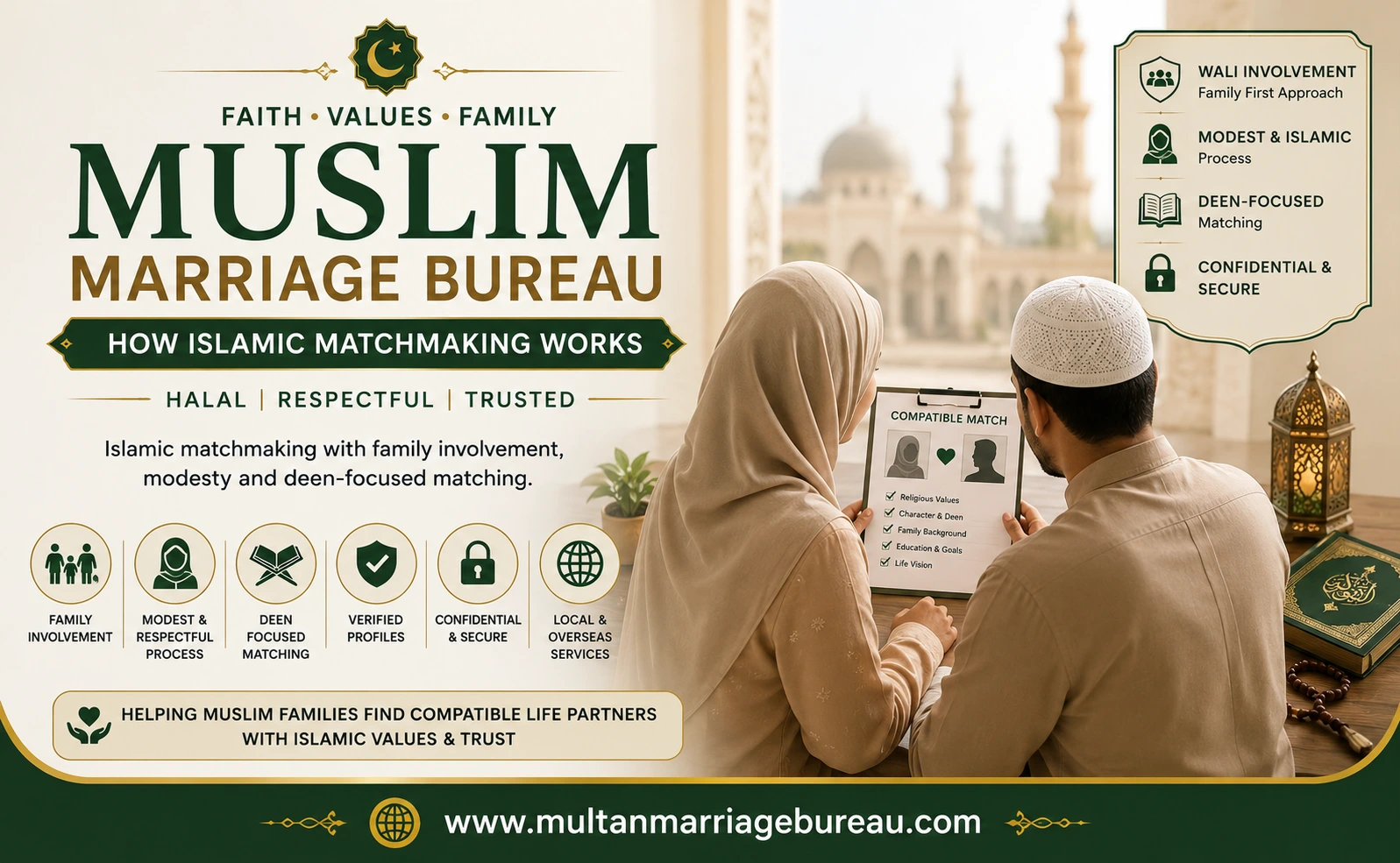
Muslim Marriage Bureau: How Islamic Matchmaking Actually Works
What separates a genuinely Islamic-conscious matchmaking process from a generic one, and exactly what to look for when choosing a bureau that respects your family's values.
Plenty of matchmaking services exist, but families searching for a "Muslim marriage bureau" specifically are usually looking for something more particular: a process that respects modesty, keeps families genuinely involved, and treats religious compatibility as seriously as education or profession. This guide breaks down what actually makes a bureau Islamically-conscious in practice, and what to check for before registering.
What Makes a Marriage Bureau Distinctly Islamic
It isn't a single feature — it's a combination of how the process is run:
Family & Wali Involvement
Parents or guardians stay meaningfully involved throughout, rather than the process happening entirely between two individuals with families informed only at the end.
Modesty in the Process
Interactions between prospective spouses are generally supervised or chaperoned, avoiding unsupervised private meetings before Nikah.
Deen-Focused Matching
Religious practice, values, and comfort level with each other's approach to faith are treated as core matching criteria, not an afterthought.
Clear, Honest Intentions
The process is oriented toward marriage from the outset, rather than open-ended getting-to-know-you with no defined purpose.
The Role of the Wali (Guardian)
The wali's involvement is one of the most discussed aspects of Islamic matchmaking, and it's worth being upfront that scholars genuinely differ on the details. Some schools of thought treat a wali's consent as a necessary condition for a woman's marriage to be valid, while others allow more flexibility, particularly for an adult woman making her own informed decision. This isn't a settled, one-size-fits-all rule — it depends on school of thought and individual circumstances.
The Islamic Matchmaking Process, Step by Step
- Registration with religious details included — alongside education and profession, the biodata typically covers prayer habits, general religious practice, and preferences like hijab or beard.
- Family-to-family introduction — profiles are shared between families first, often before the prospective spouses speak directly.
- Supervised conversation — if both families agree to proceed, a supervised meeting or call allows the prospective spouses to ask direct questions.
- Family discussion & decision — both families discuss compatibility, expectations, and practical matters before moving forward.
- Nikah — once agreed, the marriage is formalized through Nikah, with mahr, witnesses, and — depending on school of thought and circumstance — wali involvement addressed appropriately.
What to Look For in a Muslim Marriage Bureau
| Question to Ask | Why It Matters |
|---|---|
| Does the biodata cover religious practice in detail? | Ensures deen compatibility is actually assessed, not assumed |
| Are interactions supervised or chaperoned? | Keeps the process aligned with modesty expectations |
| Is the family kept informed throughout? | Reflects genuine Islamic-conscious practice, not just branding |
| Does it specialize in a particular sect or work broadly? | Helps you find a bureau aligned with your specific preferences |
| How is confidentiality handled? | Protects both families' privacy and dignity during the search |
Family Involvement, Modesty, and Honest Matching
Multan Marriage Bureau builds its process around these same values — for local families and overseas Pakistanis alike.
Register Your ProfilePractical Scenarios Worth Planning For
Differing Practice Levels
It's common for one spouse to be more religiously observant than the other. Being upfront about this with a matchmaker leads to a more honest match than assuming it'll work itself out later.
Converts & New Muslims
Many bureaus welcome converts, though it's worth discussing family background openly, since it can matter to some prospective families and not others.
Sect-Specific Preferences
If your family has a specific sect or school-of-thought preference, ask directly whether the bureau specializes or matches broadly.
Muslim Families Abroad
Muslim families in the UK, USA, Canada, Australia, and Germany face the added challenge of finding matches that share both cultural background and religious values from a distance. A good bureau accommodates this with video consultations, flexible scheduling, and the same emphasis on family involvement regardless of where the family is based.
We regularly support overseas Muslim families through our UK and USA rishta services, and connect them with our broader Pakistan-based network.
Frequently Asked Questions
What makes a marriage bureau specifically "Muslim" or Islamic?
Generally, an emphasis on family and wali involvement, modest and supervised interactions between prospective spouses, matching that accounts for religious practice and values, and a process that avoids unsupervised private meetings before marriage.
Is a wali (guardian) required for a Muslim woman's marriage?
Islamic scholars hold differing views on this — some schools of thought treat wali consent as a firm requirement, while others allow more flexibility for an adult woman. This is a genuine area of scholarly difference, so it's worth discussing your specific situation with a knowledgeable local scholar.
Can prospective spouses talk directly before marriage in an Islamic process?
Many families and scholars encourage some direct conversation to assess compatibility, but generally within limits such as family awareness, a chaperone, or a supervised setting, rather than unsupervised private meetings.
How does a Muslim marriage bureau match people on religious practice?
Many bureaus ask about prayer habits, general religious commitment, and preferences around practices like hijab or beard, so families can be matched with others who share a similar level and style of religious practice.
Do Muslim marriage bureaus only serve one sect or school of thought?
Some do specialize, such as a Sunni-focused or Shia-focused service, while others work across a broader range of backgrounds. It's worth asking directly so the bureau's approach matches your family's preferences.
How is confidentiality handled in Islamic matchmaking?
Similar to any reputable bureau, profiles should only be shared with families who've expressed genuine, mutual interest, protecting both parties' privacy and dignity throughout the process.
What if one spouse is more religious than the other?
This is common, and many bureaus specifically ask about a person's comfort with differing levels of religious practice so it can be discussed openly and honestly before a match is pursued, rather than assumed.
Can converts or new Muslims register with a Muslim marriage bureau?
Yes, and many bureaus welcome this, though it's worth having an open conversation with the matchmaker about family background and support, since this can be a meaningful factor for some prospective matches.
How does overseas registration work for Muslim families abroad?
The process is generally similar to local registration, with video consultations and flexible scheduling to accommodate time zones for Muslim families in the UK, USA, Canada, Australia, and Germany.
Does Islam encourage using a matchmaker or bureau at all?
Yes, actively seeking a suitable spouse is encouraged within Islamic tradition, and a matchmaker or bureau is simply a modern, structured way of doing what families and trusted intermediaries have long done — helping two compatible people find each other.
A Process That Respects What Matters to You
An Islamic-conscious marriage bureau isn't about following a rigid checklist — it's about keeping families genuinely involved, treating modesty as a real practice rather than a slogan, and taking religious compatibility as seriously as any other factor. The right bureau for your family is one willing to explain exactly how it handles each of these, not just claim that it does.
See How We Approach This
Register your profile or reach out to our team with any questions first.
Visit Multan Marriage Bureau